Friday, October 29, 2010

Durga & Darjeeling

After a brief personal battle with food poisoning, our week long trip to Darjeeling, India was absolutely wonderful! Before taking off for the adventure, we spent the two prior nights enjoying the festivities of Durga Puja in Agartala. Durga Puja is the largest Hindu festival of the year and for five nights, the Hindu goddess, Durga, is worshiped inside incredible man-made structures called, pandals. On a normal night in Agartala, this city is completely shutdown and silent by the hours of 9 or 10pm. However, during Durga Puja, the city never sleeps. The pandals are continuously open and welcoming of visitors at every hour of the day. To better envision what the celebrations of Durga Puja entail, imagine a combination of an American carnival, a Christmas light show, an art gallery, a music festival, and a townie fall fair. It is rather difficult to describe, but after the first night, Aja, Ellen and I felt it vaguely resembled an American gathering (minus the alcohol, but with the addition of continuous perplexed stares from local Indian civilians). We were intrigued and therefore, found it essential to attend the festivities for one additional night. During the second night, we became a bit braver and indulged into some tasty, yet spicy, street food. Lesson learned in India: Do not experiment with foreign street food the night before a much anticipated vacation involving a flight followed by an overnight train. My body was not prepared for the shock of spicy (and possibly contaminated) Agartala vendor food. The plane ride and train were pretty miserable along with the first day in Darjeeling being spent in bed, but hey, I became a professional at the use of Turkish toilets.

Andy's Guest House, our accommodations for the week, turned out to be extremely homey and welcoming. Upon arriving, the adorable Tibetan owner realized I was not feeling well after I quickly asked directions to the nearest bathroom. She immediately prepared our rooms and took the place of Moukta by ordering rest and the consumption of plenty of liquids. Andy's Guest House proved to be a perfect place to stay and I would highly recommend it to anyone who happens to stumble into this corner of the world. Warm comforters, comfortable mattresses, an actual shower head, and western toilets all made this budget hotel seem like paradise. In addition, the rooftop view of Andy's was a stunning sight to awake to in the morning. On a clear day, we had a perfect view of Mount Kanchenjunga, the third highest peak in the world. Although it did rain quite a bit, which inhibited us from actually catching a glimpse of Mount Everest, I have no complaints because being able to experience the sight of one of the highest peaks in world is an unbelievable opportunity.

The illness quickly passed and the next morning I awoke and was ready to explore Darjeeling with the rest of the group. We ate breakfast at Sonam's Kitchen, an amazing little restaurant that we revisited each morning. Fresh bread toasted with butter, vegetable omelettes, grilled tomatoes, banana and nut porridge, hash browns, real coffee, and CHEESE really made our mornings heavenly since we lack the majority of those items in Agartala. Restaurant owners and nearby tourists must have thought that the four of us had completely lost our minds because everything that we tasted was loudly, overly, and maybe even a bit, obnoxiously appreciated. The rest of our meals consisted of delicious restaurants full of pizzas, pastas, pastries, and various other “healthy” American foods. Nothing was quite comparable to foods back home, but it certainly was a nice change of pace from Indian white rice, chapati, and boiled vegetables.

As for the sightseeing, Darjeeling has gorgeous tea gardens, Buddhist monasteries situated in the clouds, beautiful temples, a busy market full of hand woven woolen goods (perfect for souvenir shopping), a welcoming and friendly Tibetan Refugee Center, and the most stunning landscapes that I have ever seen. On our last day, we rode the famous Darjeeling Toy Train back down the mountains. If it hadn't been down-pouring outside, then we would have witnessed some amazing views, but it was still a great experience and we did catch a few glimpses of the nearby scenery when we weren't completely immersed in the clouds.

Darjeeling, check!... and onto the next adventure. We are now in the process of booking our next backpacking excursion which will consist of traveling around the country for a little over one month. This will occur while the students are on their annual winter break throughout December and January. We are planning to visit about ten different cities throughout the many states of India. All four of us have now officially adjusted to the Indian way of life and feel 100% comfortable with being independent (an absolutely fantastic feeling!). I have posted many pictures of both Durga Puja and Darjeeling on facebook and you are more than welcome to check them out. Enjoy!

Thursday, October 14, 2010

Road Rage

Cars, trucks, buses, public jeeps, auto-rickshaws, bicycle-rickshaws, bicycles, mopeds, cows, goats, dogs, cats, chickens and people are the various components of the chaotic streets in India. At first glance, it is pure mayhem. A little over two months ago, the experience of having a driver chauffeur us through the streets of downtown Agartala was frightening, exciting, and adrenaline-producing. Now that I have adjusted, this chaotic way of life seems absolutely normal to me. I am afraid that upon returning to America, I may lose my license on account of forgetting that Massachusetts actually has road rules.

The major difference between driving in India and in the U.S. is that everything is completely opposite. As in England, here, the driver sits on the right, while the passenger is seated on the left, and the car is navigated on the left-hand side of the road. When the four of us first landed in Kolkata, Manish was waiting for his car along with a taxi. Ellen, Ben, and Aja rode in the taxi while I rode in the passenger seat of Manish's car. As Manish was loading my luggage into his car, out of habit, I immediately opened the front right door, as any American passenger would have, and took a seat. Upon seeing the steering wheel directly in front of me and the pedals at my feet, I quickly shot around to the other side of the car. Manish thought this was quite funny. Awareness of the fact that a passenger is seated on the left was probably a piece of information that I should have researched before arriving in India, but my lack of knowledge definitely provided some humorous entertainment for a few minutes.

Other than the one rule of driving along the left-hand side of the road (which at times is ignored), the only other glimpse that I can provide into the experience of driving along Indian streets is that it is truly every man (or animal) for himself. The only way to get from one destination to the next in any vehicle is based on the effectiveness of one's horn. The concept of honking a vehicle's horn in India is very different than at home. In America, the horn is only honked if the driver has a feeling of pure anger and frustration for another nearby driver. In India, the horn is multifunctional and may mean, “I am turning left.”, “I am turning right”, “I am stopping.”, “I am reversing.”, “I am passing you”, “I am approaching a curve in the road.”, “I am crossing a bridge.”, “Open the gate.”, “Get out of my way, cow/goat/dog/cat/chicken/human being!”. If the horn on an Indian vehicle is broken, it would most likely be classified as useless in this country. The sound of honking vehicles is my alarm clock every morning and could very well be the most commonly heard noise in India.

Everything is still going very well for all of us in Agartala! We are extremely excited to depart for our first independent excursion and head to Darjeeling in three days. Since it is still in the 90's here everyday, it will be quite a shock to be thrown into 40 degree weather and be at an elevation that it just about two times the height of Mount Washington in New Hampshire. Although I would prefer 95 degrees over 40 degree weather, I am anxious to see more of India and look forward to our trip!

Thursday, September 23, 2010

Exploring the Village Life

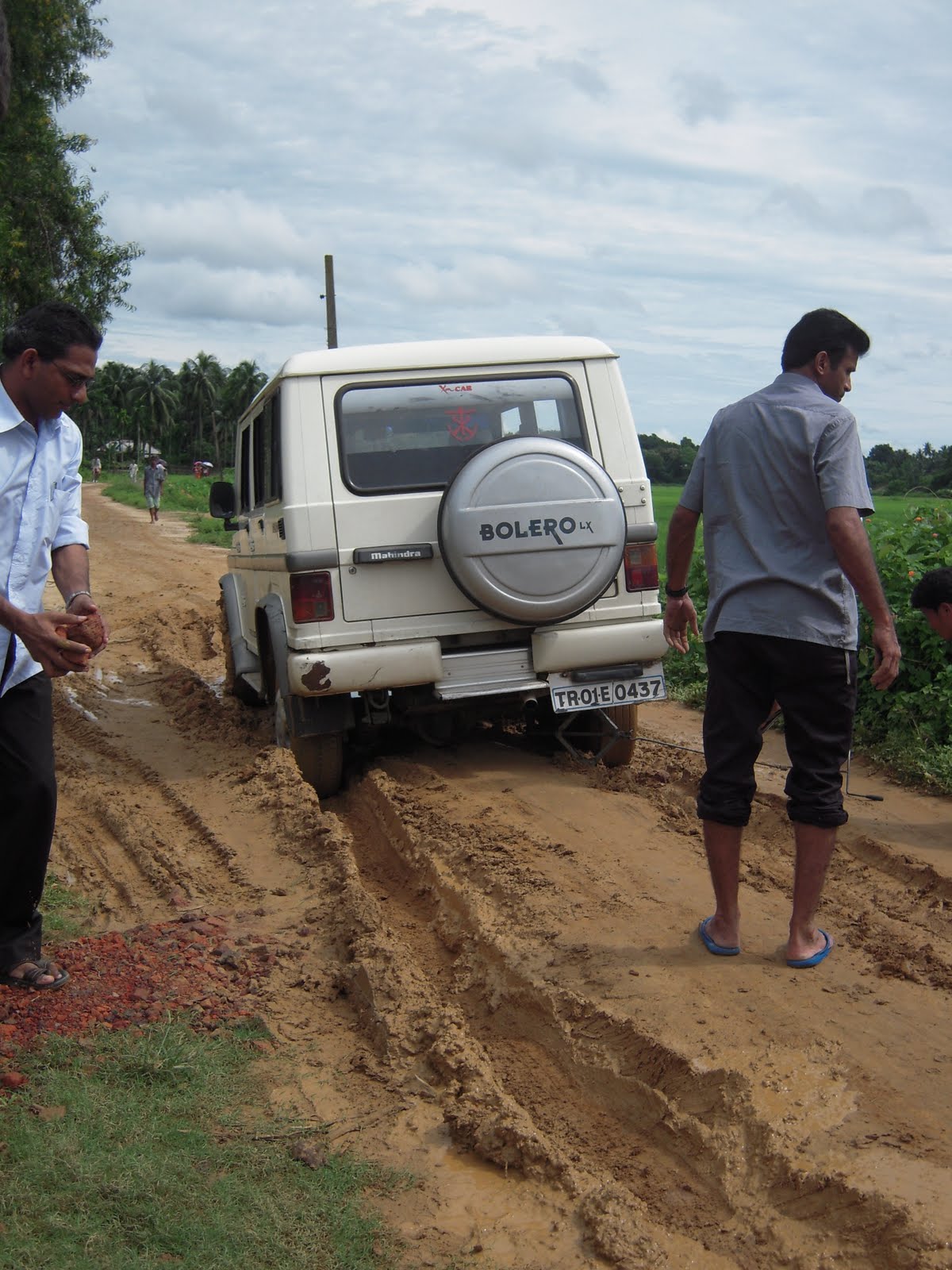
This past Sunday, Father Joe Paul invited the four of us to accompany him to a remote village in the state of Tripura. Every Sunday, he journeys out to various surrounding villages that are in need of a priest to say morning mass for the villagers. Even though the mass was spoken in the native tribal language, Kokborok, he thought it would be a good opportunity for us to exoerience the true life of a small Indian village. The car ride there was about two hours, but took a little longer than expected due to minor difficulties. Unlike America, not all roads in India are nicely paved. Most are bumpy, muddy, and greatly affected by the monsoon season. As we traveled closer to the village, the roads were extremely uneven and muddy, which made driving rather difficult. A couple of miles outside the village, our car got stuck in the mud and Father Joe Paul and local villagers had to push the car free. After that aggravating, but humorous battle, we decided to park the car on the side of the road, and walk the remaining two miles.

Upon arriving a bit late, all of the villagers were already gathered and singing in the small church with a bamboo roof. They were anxiously awaiting Father Joe Paul's arrival and were extremely excited to see that four American guests had stumbled into their community. Mass was said in Kokborok and afterward, Aja, Ben, Ellen, and I were warmly welcomed with flowers and hundreds of handshakes. The four of us and Father Joe Paul were then invited to the house of the President of the village for lunch. Before the meal was prepared, one of the villagers picked fresh guavas off of a nearby tree for us to eat. I had never tasted fresh guavas before arriving in India and they are delicious! None of us have ever seen them for sale in the Boston area, but hopefully we will be able to find some when we return.

Lunch was soon ready and consisted of white rice, a fish curry mixture, a rather spicy chutney, and a piece of fish. I have grown to love the curry mixtures here in India! However, utensils are not an essential part of life for local Indians, which is always a challenge for utensil-dependent Americans. Before this experience, we had only attempted to eat a rice meal with our hands once, which turned out to be pretty messy, but also really amusing! There is also a science behind the hand-eating technique. You want to mix just enough curry into the rice so that it clumps and is easy to grasp. If you mix too much or not enough curry, you are soon faced with a feeding struggle. It is surprisingly enjoyable to eat with your hands once you learn the proper hand-feeding technique!

After the meal, we cleaned our hands, were directed to use the “bathroom facilities” (in which we were asked, “Number 1 or 2?”), and then began our two mile walk back to the car. By the time we had reached the car, we had many animal followers such as, dogs and goats. Only in India does a leisurely walk remind you of Noah's Ark. The village experience was one that I would love to revisit in the future. Traveling to this remote location was a true immersion into a foreign culture and it was great to escape the Holy Cross safety-net that we have in Agartala.

On a side note, since I am talking a bit about the unique culture in India, I have posted a video below of a few performances that occurred on Teacher's Day, an annual Indian holiday in which students honor their teachers. These cultural dances were choreographed by the students and I thought everyone might enjoy a taste of the cultural programs that I attend quite frequently! The first two dances are classical Indian routines while the third clip is a performance from a well-known Bollywood film, "The Three Idiots". Thank you to the Connolly, Costantiello, and Abbott Families for the FlipCam!

Saturday, September 11, 2010

A New Adventure Everyday

Despite one of us becoming a bit sick and the occurrence of a small earthquake, everything is still going very well in India! At around midnight last night, Ben spiked a fever along with other symptoms and was taken to the hospital accompanied by Ellen and a very helpful friend of ours from Holy Cross, Biju. Aja and I stayed behind because four Americans tagging along in a hospital late at night would have been a little overwhelming for everyone involved. However, after receiving an IV and rehydrating, Ben is recovering and well taken care of. From what both of them reported back to us, health care is on a completely different page here in India than in America. Upon arriving at the hospital, it was very common to find homeless individuals and even dogs sleeping on the floors of the late night care unit. There were IV lines, dirty clothes, and trash on the ground of the hospital, displaying the lack of concern for sanitation. What surprised me most (being a health care nerd) was the fact that health insurance is generally not spoken about at all. When a patient enters, they are seen by a doctor/nurse and that medical professional gives the patient a list of needed supplies and medication depending on the diagnosis (ie: needles, syringes, antibiotics, IV lines, etc.). That list is to be taken to a nearby pharmacy and, as the patient, you, or a friend or family member, is responsible for paying for each item in order to take back to the doctor/nurse. Once everything is purchased, the treatment may proceed. This approach definitely ensures that health care is being paid for by the individual, but it lacks efficiency. The process is much slower than the operations of an emergency room in America because the needed supplies and medications are not readily available to the doctors and nurses. Another huge downfall to this approach is that those individuals who cannot afford to buy supplies and medications at the pharmacy will not receive care. Hopefully none of us will have to return to the hospital in Agartala; although, it would be extremely interesting to experience this atmosphere in person.

As for the earthquake, it occurred at the same time that Ben was very sick which made last night pretty eventful. The earthquake was very small and there were no reported damages or injuries. It was the first time that I had ever felt an earthquake which initially made it a bit scary, but also really exciting. Northeast India is situated on a fault line which makes the area prone to such events. It only lasted about ten seconds or so and it was a 4.8 on the Richter Scale, situated over Bangladesh. The good news is that it was nothing major and we are all perfectly fine!

On a lighter note, the pictures that I have attached to this post (and one on the previous post) are of a recent journey in Tripura to one of the holiest Hindu temples in this part of the country, Sundari Temple, and also to Neermahal Palace, a unique piece of architecture built in the middle of a lake and only accessible by boat. I also tossed a picture in this post of myself with some of the adorable nursery school students. Enjoy!

Thursday, September 2, 2010

Becoming a Teacher

Sorry I haven't updated in quite a while! The internet here has been down and is still in the process of being fixed. Anyways, these past three weeks have been quite an eye-opening experience into the education system here in India. Before I begin with my personal thoughts and feelings, let me first briefly explain the structure of the Indian education system. As I mentioned in a previous post, Ellen and I are teaching at the Holy Cross School, consisting of a mix of local Bengali students and native tribal students. Ben and Aja are working at the Blessed Andre School which is 99% native tribal students. Keep those facts in mind...

There are many daily and independently run after school programs referred to as, tutions, where students' parents pay certain adults to re-teach their children the same material that is learned in school. Parents believe that tution solidifies their children's knowledge and ensures the passing of exams throughout the year, allowing them to move on to higher grades. Tution also relieves parents of homework and study duty. Only children who can afford these tution programs may attend (the majority of the Bengali students). Most tribal students are not as financially well off as the Bengali students; therefore, these children do not have the “luxury” of attending tution. The Bengali students who attend tution have no motivation or reason to stay attentive throughout the school day because they know that the material will be presented to them again in the evening. The majority of the students at the Blessed Andre School do not attend tution and are eager and willing to learn in the classroom. However, it is quite the opposite at the Holy Cross School. These children are attending tution on a daily basis, making it extremely difficult to keep the class engaged for even a 35 minute period. You can see that this system needs a bit of restructuring, but the four of us try to stay positive and overcome the tution interference.

I am teaching five English Language classes to 6th, 7th, and 8th graders and one Moral Science class to a class of 7th graders, each consisting of fifty students. One teacher attempting to control fifty inattentive and rowdy students, let me tell you, is not a simple task. I should not say that all three hundred of my students do not pay attention to my lessons because there are a number of children who are eager to learn. I feel sorry for these students because I was brought here to teach, but some of their peers make teaching nearly impossible at times. This classroom atmosphere was nothing that I had ever experienced in America and it was extremely shocking at first, but I am adapting to the fact that the classroom will never be entirely silent for more than two minutes. The teaching aspect of this adventure has been quite frustrating at times, but it is also the most exciting. No day is like the next. Some days, I walk out of the classroom on top of the world and knowing that I connected with at least one student. Other days, I come home with a sore throat from hours of shouting and ask myself, “What exactly did I sign up for?” Although, to some degree, I suppose those feelings come along with any job. There are always going to be amazing days mixed with those that are frustrating.

Outside of the classroom, Ellen and I spend some of our mornings with the girls that live in the hostel and also with the little ones in the Holy Cross Nursery School. Since the classroom can be a bit difficult at times, I believe that spending my mornings with both of these groups will be the most rewarding and fulfilling part of my teaching duty here at the Holy Cross School . Spending time with the hostel girls allows me to have one-on-one tutor sessions and these girls are my teachers as well. I have gained insight into their specific tribal cultures, Indian dances, unique arts and crafts, foreign pop culture, etc. At the nursery school, the children are so young that their English is not at a fluent level; however, they are extremely adorable! The children sing, dance, color, play games, and are quite interested in the shapes of my Silly Bandz. Spending a morning at the nursery school is an uplifting start to the day.

Everything is going well for all of us in India so far! We are all adapting to the culture very quickly and are able to hail an auto-rickshaw (basically an open metal box with three wheels... kind of scary) and venture into downtown Agartala on our own. We even booked our first trip for our break in October. During this month, school is dismissed for two weeks for those of the Hindu religion to celebrate Durga Puja, the largest of the Hindu holidays (comparable to our Christmas). The first of the two weeks, we will be working at a peace camp at the Holy Cross School, while experiencing the festivities of Durga Puja. The second week, the four of us will be heading into the Himalayas to a city called Darjeeling. From there, we will be able to see some of the highest peaks in the world including, Mount Everest. Darjeeling also has world famous tea plantations, a variety of monasteries, hiking, incredible views, and based on restaurant reviews, we may even get the chance to experience many missed American foods and drinks! Lonely Planet categorizes Darjeeling as a “must see” so, we're excited to make the trip!

Monday, August 16, 2010

Our First Bengali Wedding

Last night, the four of us took a trip with Father Joe Paul to Simna, a village just about an hour from Agartala, to attend our first Bengali wedding. Aja, Ellen, and I dressed in salwar kameez, typical Indian tunic and pant dress, and the five of us presented the bride with a pot, which we picked up on the ride there, as our wedding gift. The wedding was for the sister of one of the teachers at the village school, who we had befriended this past week. Indian wedding invitations are not nearly as exclusive as those in America. We were extremely excited to have been offered the experience of attending a Bengali wedding so, we graciously accepted the invitation. The wedding was to take place at the house of the bride's parents.

The drive to the wedding was beautiful, passing through numerous tea farms and rubber tree orchards. At one point in the journey, we encountered a portion of land extremely close to Bangladesh and commonly called, “No Man's Land”. This land is neither the territory of India nor Bangladesh and it sits as an unclaimed piece of this world. Upon entering “No Man's Land”, from a border guard, we received a token with the number "5" (representing the number of individuals present in the vehicle) and then drove through this unclaimed land for approximately one mile until we bumped into Indian territory. At this point, we returned our token to the guard and were allowed back into the country of India. It was a very interesting and strange experience because prior to this road trip, I was unaware that there were significant portions of land in the world that have yet to be claimed.

The wedding itself was such a joyous celebration for everyone involved, except the bride. This young bride (no older than 18) was unaware that she was going to be marrying a man until she was told one week ago. I know that I must remain respectful to the culture in which I voluntarily threw myself into; however, the entire process of arranging marriages in India is a concept with which I cannot seem to grasp. There are people in this country who spend their entire professional careers as, “Marriage Brokers”. These individuals are hired by families with children, who are of marriage age (typically females are 18 and males are 21), and they seek out potential husbands and wives in nearby villages based on age, family name reputation, horoscopes, education, income, etc. In America, it is fairly standard to attend a wedding full of love, beauty, and with an overall joyous atmosphere for every individual involved. I am fairly confident that the majority of young females in India presented with an arranged marriage, are quite upset to be forced upon a husband and faced with the concept of leaving their home and family forever. Let's be honest, who would find that predicament appealing?

Upon arriving at the brightly lighted entrance to the wedding festivities, we were treated with such respect and it was quite apparent that family and friends were honored to have Americans attend the wedding. We had an amazing meal with extreme variety including, rice, chicken, paneer (milk/cheese tofu), goat (yes, I did in fact eat goat!), fried fish, fish head curry, dahl (lentil soup), some sort of sweet and sour drink with anise (I chose to avoid this dish...), and desserts both before and after the main course. We had our own private dining area with about ten caterers waiting on us and snapping photographs of the Americans from time to time. I am sure that I will become used to the fact that, as Americans, we will continuously receive a different level of respect here in India, but as for now, I feel as if I am experiencing such a surreal and exciting life.

After the meal,we sat in the tented room in which the marriage ceremony will take place later in the evening. We did not stay for the ceremony, as it is not important for invited guests to attend this portion, but we did receive an explanation of the many different sections of the room. In the front, there was a intricately decorated gazebo in which the actual marriage would take place. In the back of the room, a new bed, surrounded by gifts, was assembled for the couple's “first night”. In between the two sections, guests were socializing, dancing was taking place with a small Indian band accompanying music from time to time (see the attached video), and various rituals were apparent. Soon after we received insight on a typical Bengali wedding, it was time to present our gift to the bride, who we had yet to see. We entered her room and collectively noticed her depressed and saddened state. Her eyes were bloodshot from crying and all she was capable of was a simple head bow in appreciation for our gift. Her brother, the teacher from the tribal school, insisted that we take a picture with her, although it felt extremely uncomfortable for us (the picture is posted in this entry). This young girl was being forced into a loveless marriage and taken away from her family. I had to fight back tears because through my American eyes, I still saw a child. We expressed our feelings to Father Joe Paul (we joke that he is our Dad here in India and Moukta, our cook, is our Mom) and he said that, in the Hindi religion, it is quite typical for the bride to feel depression and fear on her wedding day. The majority of Hindi marriages in India are arranged, but some love marriages do exist, depending if the family accepts the son or daughter's spouse choice. The four of us will continue to be invited to weddings throughout the year and I hope that we experience at least one love marriage. It will be interesting to witness the difference between the two types. Even though I was emotionally bothered by the arranged marriage concept, it was great to be able to experience yet another element of this culture that is far outside my comfort zone.

On a side note... I received my class schedule and will begin teaching this week! I will be responsible for 6th, 7th, and 8th grade English Language classes along with 7th and 8th grade Moral Science classes (a combination of Psychology and Sociology). I met some of my students today at our Holy Cross School welcoming ceremony and I look forward to a weekly routine of teaching!

Sunday, August 8, 2010

A New Way of Life

A few days ago, the four volunteers had a meeting with three of the Holy Cross administrators and we decided where each of us will be teaching throughout our year of service. Along with Ellen, I will be teaching at the Holy Cross School until the end of December and Aja and Ben will be teaching at Blessed Andre, the tribal village school. After Christmas break, Ellen and I will switch sites with Ben and Aja so that all four of us will have the same experiences here in India. In a few days, we will be told more on which specific classes each of us will be teaching. However, it sounds like we will all be teaching some sort of English class (Grammar, Literature, Shakespeare, etc.), but we also will have the opportunity to teach a subject in which we have a strong interest. I hope to teach some sort of math or science course since those are the fields in which I have been involved with this past year at graduate school.

During this past week, we took our first, of many rides, to the police station in downtown Agartala to apply for a residence permit with the Indian government. Since arriving in India, this outing was the first time that I truly noticed that by being Caucasians in Northeast India, the four of us are capable of producing some rather large crowds. The moment that our flight landed in New Dehli, I became a minority in this country, which is something that I have never had to face back home. Although these crowds can sometimes feel uncomfortable, from what I have experienced, Indians mean no harm by gathering, staring, and taking pictures; more so, we draw this attention because Aja, Ben, Ellen, and I may very well be the only Americans in the entire state of Tripura. This is one reason why the Extension India program was created. It enables the children and surrounding civilians of this area to be exposed to individuals from a culture and ethnicity outside of their comfort zone, while the four of us are subjected to the same situation, only reversed. As a group, we may not make a huge impact on the lives of our students by teaching them the proper usage of adjectives and verbs but, by assimilating to their culture and values while opening our lives up to them is where the impact will take place.

Besides the stares that we received at the police station, I was even more taken aback by the overall level of efficiency that occurred in the office that dealt with passports and visas. It was if I had stepped into a time warp and traveled many years into the past. There were old fashioned typewriters, never-ending stacks of papers, and a lack of overall organization. This is their way of life, but it became humorous in time because we were told to revisit the office again and again on numerous occasions in order to add more information to our residence request. In fact, we have to stop by the office on Monday once again. The way any matter is handled in India is completely different than in America. When something needs to be taken care of or fixed, the individual in charge of that specific problem takes care of it when the time is right for them and when they are able to get around to it. Whereas, in America, that is perceived as rude. Here, we never know when the internet repairman will arrive, if we ever will be granted a residence permit, or even what time to set our alarm in the morning for certain events. Yesterday, I woke up to Father Joe Paul in my window exclaiming, “Good morning! Good morning! 9am zoo!” The four of us have definitely learned to turn our frustration into laughter, brush it off our shoulders, and are excited to continue learning the way of life in India.